

What makes international online shopping safer is not just choosing a familiar website. It’s knowing who is selling the item, how payment works, and what to expect from delivery and support. The question “is it safe to buy online from abroad in Ethiopia” has no one-size-fits-all answer. The details of the seller, product listing, payment route, and delivery terms all matter.
Fake sellers, misleading listings, counterfeit goods, and delayed or missing parcels are reasonable concerns. A local payment option can make checkout easier, but it does not automatically protect a purchase. Review the order details before paying so you can spot warning signs and make an informed choice.
This guide explains what to assess before placing an international order, from seller and listing checks to payment, delivery terms, and support. It also explains how CommercePal connects Ethiopian shoppers with products from global retailers and local payment options including Telebirr, CBE Birr, and eBirr. A locally adapted shopping route can make the process easier to follow, but it is still important to review the details of each order.
Key Takeaways
- “Is it safe to buy online from abroad in Ethiopia” depends on the seller and each step of the purchase, not simply whether the retailer is overseas.
- Compare product details, seller signals, payment methods, delivery terms, and support before you place an order.
- Use the before-you-pay checklist to catch unclear listings and unexpected costs before checkout.
- Direct retailer purchases and marketplace or shopping-facilitator routes can involve different payment and delivery steps.
- CommercePal connects Ethiopian shoppers with global retailers and local payment options, including Telebirr, CBE Birr, and eBirr.
Is It Safe to Buy Online from Abroad in Ethiopia? Understand the Real Risks
Yes, buying from abroad can be safe for shoppers in Ethiopia, but safety depends on the seller and the steps involved in the purchase. A familiar marketplace name is not a guarantee: sellers, listings, payment arrangements, and delivery terms can vary. To answer “is it safe to buy online from abroad in Ethiopia,” assess the whole transaction instead of relying on the platform name alone.
A safer cross-border purchase is a traceable transaction with clear terms at every step. You should be able to identify who is selling, understand what you’re buying and how you’ll pay, and keep the order confirmation and delivery updates. These records make it easier to follow up if a problem arises. They reduce uncertainty, but they can’t guarantee that an order will arrive as expected.
What makes an international online purchase safer?
Start with the seller’s identity and track record. Look for consistent business details, relevant buyer feedback, and product information that answers practical questions about the item’s condition, size, model, or compatibility. Compare those details with the checkout summary. Review the payment and delivery terms before confirming the order, then save the listing, payment confirmation, order number, and messages. Together, these records help you track the purchase and explain a problem clearly if you need support.
Consider each part of the transaction separately. A convenient payment method may not resolve a dispute; a well-known marketplace may host a questionable listing; and a detailed product page can’t prevent shipping delays. Ethiopia’s wider push toward digital services is outlined in the Digital Ethiopia 2030 strategy, but national digital goals aren’t a substitute for checking the seller and transaction in front of you.
Which risks should Ethiopian shoppers consider?
Look beyond whether checkout works. Misleading photos or vague descriptions can result in an item that differs from what you expected. A payment dispute may be harder to resolve if the seller’s terms are unclear or you haven’t kept proof of the transaction. International shipping can also take longer than expected, and tracking may not show every stage before local receipt.
Check return terms and after-sales support before paying. Find out what steps the seller requires for a return, who handles it, and how to reach support. Don’t assume an overseas return will be simple or that a marketplace name guarantees a refund.
Customs requirements and product restrictions can vary by item and may affect what you can import or what steps are needed. Before ordering, verify current requirements with the relevant Ethiopian authorities, especially for goods that may be restricted. Treat customs as a separate part of the buying decision, not an automatic outcome of a successful checkout.
How Overseas Shopping Works from Ethiopia: Sellers, Payments, and Delivery
An international order usually moves through several stages: you choose a listing, place and pay for the order, receive confirmation, follow shipment updates, and take receipt of the item locally. Track the listing, payment, order confirmation, shipment, and local receipt as separate stages. Knowing which party is responsible at each point helps you find the right place for updates or assistance.
Direct retailer purchase versus a shopping marketplace
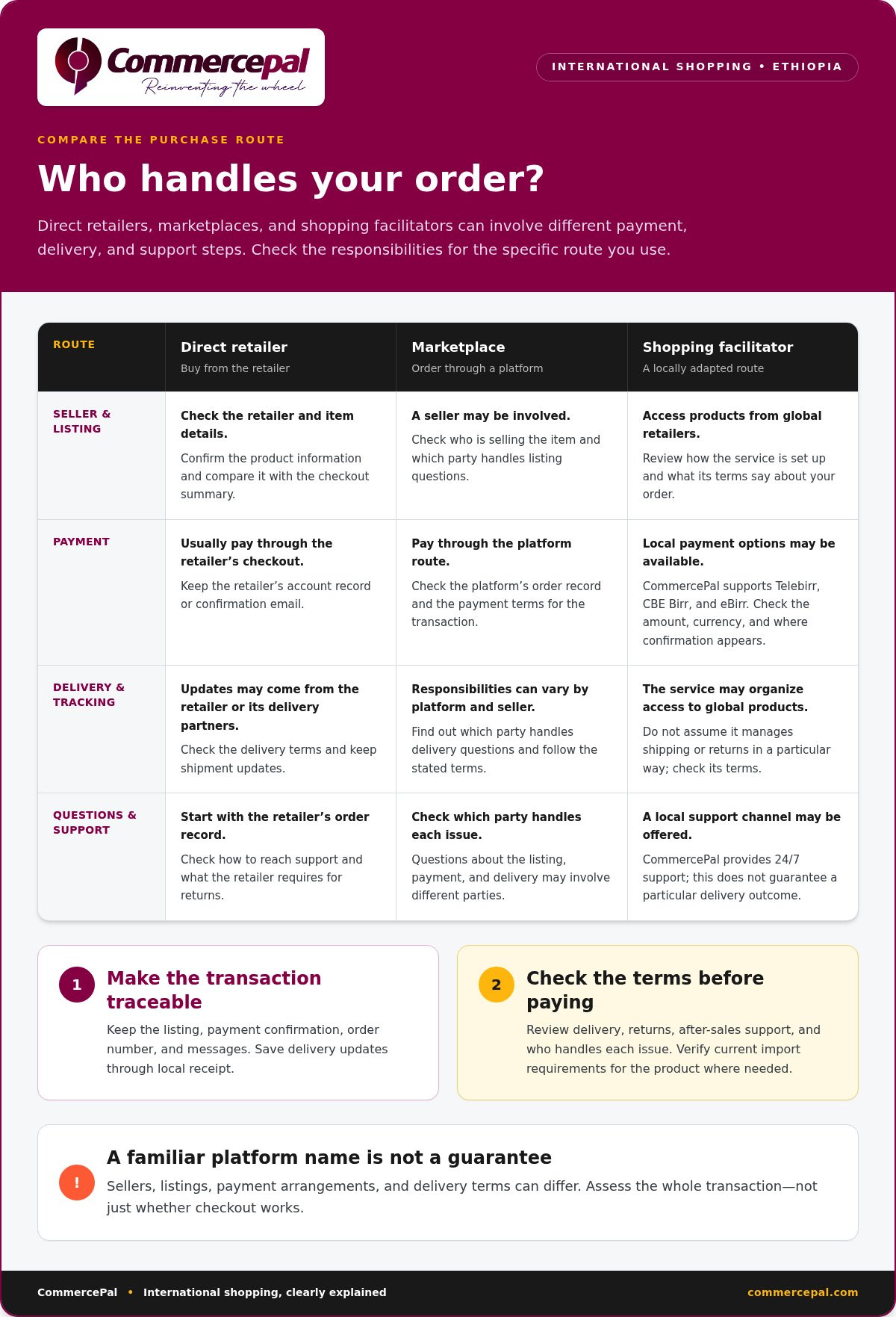
With a direct purchase, you usually place the order and pay through the retailer’s checkout. The retailer’s account or confirmation email is the main record of the purchase, while shipping updates may come from the retailer or its delivery partners. With a marketplace, you browse and order through a platform, but an individual seller may be involved. Keep the platform’s order record and check which party handles questions about the listing, payment, or delivery.
A shopping facilitator can offer another route by organizing access to products from global retailers, accepting a local payment method, and providing a local support channel. The order records and responsibilities depend on how the service is set up. Don’t assume every marketplace or facilitator manages shipping, returns, or disputes in the same way. Read the terms for the specific route you’re using.
What Ethiopian shoppers should know about payment and delivery
Payment options depend on the checkout route. CommercePal supports local options such as Telebirr, CBE Birr, and eBirr, which can make paying for international products more accessible. Before confirming, check the amount and currency shown, where payment confirmation will appear, and how to find your order status. The U.S. Department of Commerce’s overview of eCommerce in Ethiopia provides context on local payment systems and the online retail environment.
After payment, look for an order reference and updates that distinguish processing from shipment. Delivery arrangements and tracking details vary by purchase route, so keep the seller’s or platform’s stated terms. For questions about an order, use the support channel connected to that transaction. CommercePal provides 24/7 support, a customer-service feature that does not guarantee a particular delivery outcome.
Customs and import conditions can depend on current requirements and the product category. Check applicable official guidance for the item before ordering, especially if it may be subject to restrictions. The answer to is it safe to buy online from abroad in Ethiopia also depends on whether you can see and understand each stage before paying. To explore a locally adapted route to global products, visit CommercePal’s international shopping marketplace.
How to Spot Risky Overseas Listings Before You Pay
An international purchase isn’t automatically unsafe, but a familiar marketplace name alone doesn’t make every seller or listing trustworthy. Slow down and compare the details. If product information, payment steps, or support terms are missing, don’t let a countdown or “limited offer” push you into paying before you understand the order.
Which seller and product signals deserve a closer look?
Check whether the seller’s details and product description stay consistent from the listing through checkout. Compare the model, size, condition, included accessories, and delivery terms shown in both places. Reviews can offer useful clues, especially when they describe the exact item and buying experience, but they don’t prove that every order will go smoothly. The Ethiopia Country Commercial Guide for eCommerce offers broader context on online shopping and payment conditions in Ethiopia. Use it alongside checks of the specific listing.
| Signal | What to look for | Action to take |
|---|---|---|
| Reassuring | Specific product details, consistent seller information, clear delivery terms, and relevant reviews. | Compare the listing with the checkout summary and save a copy before paying. |
| Warning sign | Vague specifications, conflicting seller details, or claims that don’t match the product description. | Pause. Don’t order until the important details and terms are clear. |
| Warning sign | Pressure to pay immediately, unusually attractive claims without clear terms, or requests to pay outside the stated checkout. | Don’t let urgency override your checks. Keep payment within the route shown for the transaction. |
| Reassuring | A clear order record and an identifiable support channel for questions. | Keep confirmations and use the listed support route if you need help. |
Which payment and communication warning signs matter?
Be cautious if a seller asks you to move payment to a personal account, a separate link, or another channel outside the checkout process. This can make it harder to identify who received the payment and where to find the order record. If the payment instructions or support details are confusing, stop and review them before continuing.
Never share your password, one-time verification code, or personal information that isn’t needed to complete the purchase. Keep order conversations and receipts in the marketplace or service’s official records where possible. If key terms remain unclear, walk away rather than relying on pressure. A safer answer to “is it safe to buy online from abroad in Ethiopia” starts with verifying the seller, item, payment route, and terms before submitting the order.
A Before-You-Pay Checklist for Buying from Abroad in Ethiopia
Use this checklist before submitting an international order. It brings the key details together so you can catch unclear terms before paying. Reviewing each step helps you decide whether you’re comfortable proceeding.
What to verify in the listing and checkout
- Identify the seller. Check the seller’s name and details on the listing, then make sure they remain consistent through checkout.
- Confirm the exact item. Match the product name, model or specifications, quantity, condition, and included parts to what you intend to buy.
- Review the final amount. Check the total and currency shown at checkout, along with any extra charges stated there. Don’t rely only on an earlier listing price.
- Understand the payment route. Make sure the instructions match the checkout process and that you know where to find payment confirmation.
- Read the delivery terms. Review the delivery estimate, tracking details, and how updates will be provided. Treat an estimate as guidance, not a guaranteed arrival date.
- Check returns and support. Find the stated return conditions and support channel. Understand who to contact if the item differs from its listing.
- Review import requirements. If customs requirements or product restrictions may apply, check current official Ethiopian guidance for the product category before ordering.
Pause if the checkout summary differs from the listing or important terms are missing. Don’t fill gaps with assumptions. Reviewing the details first helps you decide whether you’re comfortable proceeding.
What to save and do after placing an order
Keep the product page, seller details, checkout summary, payment confirmation, order reference, and customer-service messages. These records give you a clear timeline if you need to follow up. After ordering, use available tracking and contact the listed support channel if expected updates stop or you need clarification.
For more guidance on comparing international shopping options, use the checks in this guide to compare seller details, payment routes, and delivery terms. When you’re ready to browse global products through a locally adapted marketplace, explore CommercePal’s international product selection.
How CommercePal Makes International Shopping More Accessible in Ethiopia
Once you’ve checked the seller, listing, payment route, and delivery terms, choose a buying route that fits how you prefer to shop. CommercePal offers shoppers in Ethiopia a locally oriented way to explore products from global retailers. It brings international product discovery together with local payment options and customer support, making the process easier to follow.
How a locally adapted marketplace can reduce shopping friction
CommercePal features products from global retailers including Alibaba, Shein, and Amazon. Shoppers can explore products from these sources through one locally adapted marketplace instead of starting separately on each retailer’s website. Local payment methods include Telebirr, CBE Birr, and eBirr, offering alternatives to paying directly with an international card.
CommercePal also provides 24/7 support, giving shoppers a customer-service channel during the shopping journey. This can help with questions about using the marketplace or following an order. Easier access is not a guarantee: a marketplace doesn’t automatically ensure that every seller is reliable, every listing is accurate, or every shipment arrives as expected. Review the product and transaction details before ordering, and keep your confirmations for reference.
Choose your next step with confidence
Use the checks in this guide as you decide: review the seller and listing, understand the payment route, read delivery and return terms, check current import guidance for the item, and save your order records. These steps help you make a considered choice, whether you buy directly from a retailer or use a locally adapted marketplace.
If you’re comparing international shopping options, read Amazon vs Global Retailers Ethiopia: Which Global Marketplace Wins in 2026? for a focused comparison.
Shop Globally with a Clearer Plan
So, is it safe to buy online from abroad in Ethiopia? It can be, when you check the seller and exact listing, understand the payment and delivery terms, and keep your order records. Review current import guidance for the product too. A careful process won’t remove every risk, but it helps you make a more informed choice before paying.
CommercePal offers a locally adapted way to explore products from AliExpress, Alibaba, Shein, and Amazon, with local payment options including Telebirr, CBE Birr, and eBirr. Its 24/7 customer support can help make the shopping journey easier to follow. CommercePal also offers cashback incentives. These features support access and convenience, not guaranteed seller or delivery outcomes.
Ready to browse? Explore global products with CommercePal and use the checklist as you shop. Compare the details, take your time, and move forward with confidence.
Frequently Asked Questions
Is it safe to buy online from abroad in Ethiopia?
It can be safe, but it depends on the seller and how clearly you can follow the purchase. Check the seller’s details, product description, payment process, delivery terms, and support channel before paying. Keep your order and payment records. No marketplace or payment option can guarantee that every item will match its listing or arrive on time, so pause if important terms are unclear.
How can I tell if an international shopping website is trustworthy?
Look for clear business and seller information, specific product details, transparent checkout terms, and an order record you can access after payment. Read relevant reviews as clues, not proof, and compare the listing with the final checkout summary. Be cautious if the seller’s details conflict, the offer relies on pressure, or you’re asked to pay outside the stated checkout process. Don’t share passwords or verification codes.
Can I pay for overseas online shopping with Telebirr or CBE Birr?
Yes, Telebirr and CBE Birr are local payment options available through CommercePal. eBirr is also supported. This doesn’t mean every overseas retailer accepts these methods directly; payment choices depend on the route you use. Before paying, check the method shown at checkout, the amount and currency, and how you’ll receive confirmation. Save the transaction receipt and order reference together.
What should I check before ordering a product from abroad?
Confirm the seller, exact item, quantity, and specifications, then compare them with the checkout summary. Check the displayed total and currency, payment instructions, delivery estimate, tracking details, return terms, and support channel. Consider whether customs requirements or product restrictions may apply, and consult current official Ethiopian guidance for the product category. Save the listing and terms so you can refer to them after ordering.
What happens if an international order is delayed or does not arrive?
Check the order status and tracking information first, then compare the latest update with the stated delivery estimate. Keep your payment confirmation, order reference, listing, and messages. Contact the support channel shown for the purchase and explain the issue with those records. The next steps depend on the retailer or marketplace’s terms and the delivery route. Don’t assume a delay automatically means the order is lost or refundable.
Are overseas online purchases subject to customs requirements in Ethiopia?
They may be, and requirements can depend on the product category and current rules. Before ordering, consult current guidance from the relevant Ethiopian authorities, especially if the item may be restricted or require additional steps. Don’t assume checkout includes every customs-related requirement or charge. Keep the product description and order documents available, as they may help you understand what you bought if questions arise during the import process.
Is it safer to use a marketplace than to buy directly from an overseas seller?
Not automatically. A marketplace may bring listings, payment records, order updates, or customer support together, but sellers and policies can differ across platforms. A direct retailer purchase may provide a clear account and order history too. Compare the seller, product details, payment route, delivery terms, returns process, and support for the specific purchase. Choose the route whose terms you can understand and whose order records you can access.


