

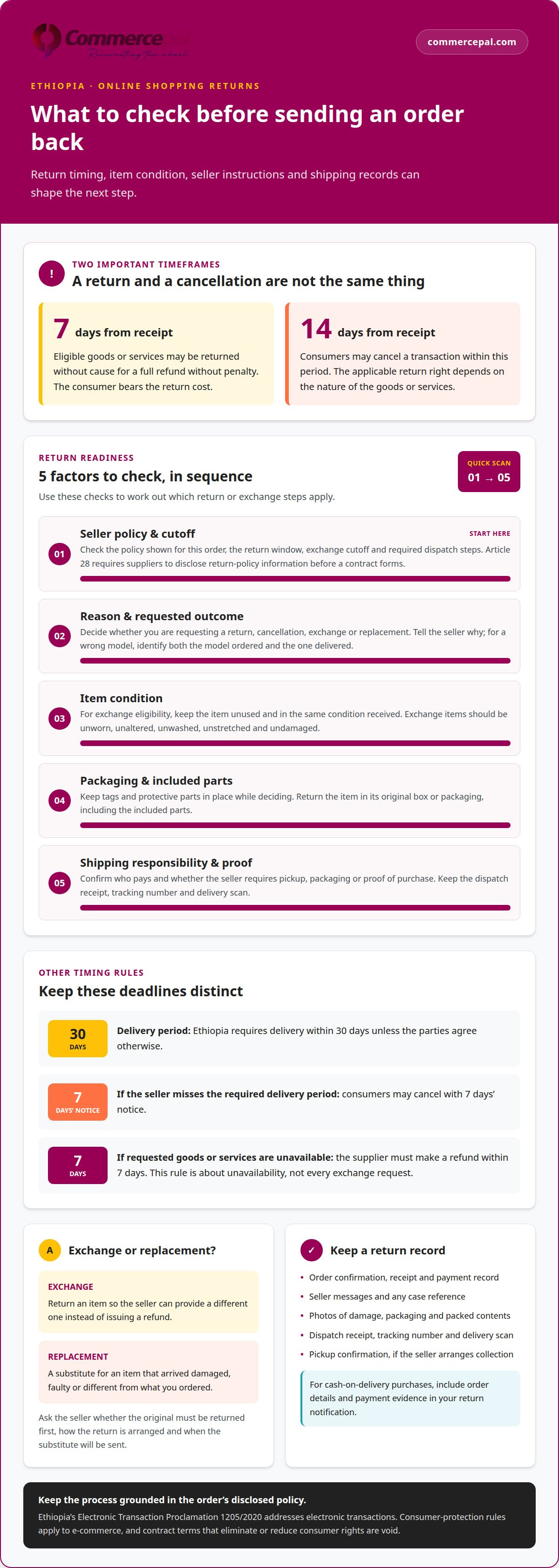
Return shipping can be your responsibility in Ethiopia. For eligible goods or services returned without cause within 7 days of receipt, consumers may receive a full refund without penalty while bearing the return cost. The online shopping return policy in Ethiopia also allows consumers to cancel a transaction within 14 days of receiving goods or services.
Before sending an order back, check the seller’s return policy, the return window, the reason for return, and the item’s condition. These details determine which steps to take.
Check who pays for return shipping and what the seller requires for exchanges, packaging, replacements, and proof of purchase. Knowing these requirements can help you prepare the return and keep the right records.
Next, we’ll explain the key rules and practical requirements, so you can move from an unwanted or unsuitable order to a clearer return or exchange process.
Key Takeaways
- Understand when return postage may fall to you and how the reason for the return can affect the process.
- Keep exchanged items unused and in their original packaging to meet common condition requirements.
- Learn how to approach an exchange or replacement when the requested item needs to be substituted.
- Keep order and payment records handy so you can support a return request and identify the purchase.
Return shipping costs
Return shipping is the cost of sending an online order back to its seller. Under Ethiopia’s online shopping return policy, consumers may return eligible goods or services without cause within 7 days of receipt and receive a full refund without penalty, while bearing the return cost. Ethiopia’s Electronic Transaction Proclamation 1205/2020 addresses electronic transactions, including this return right. Before posting an item, save the seller’s return instructions and note who pays for its journey back.
A return window is the period for cancelling or returning an order. The online shopping return policy in Ethiopia allows consumers to cancel a transaction within 14 days of receiving goods or services. The applicable return right depends on the nature of the goods or services. If a delivery is delayed, Ethiopia requires delivery within 30 days unless the parties agree otherwise. If the seller misses the required period, consumers may cancel with 7 days’ notice.
Tracking records a parcel’s movement. Keep the tracking number, dispatch receipt, and delivery scan with your return request. If tracking stalls, share the latest scan with the seller and ask how the delay affects the return. The dispatch receipt can help show when you handed the parcel to the carrier, even if tracking has not updated.
An exchange shipping deadline is the seller’s stated cutoff for requesting or sending an item for exchange. Article 28 requires suppliers to disclose a return policy before a contract is formed. Find the exchange cutoff in that policy, then send your request and follow its stated dispatch steps. Don’t assume an exchange has a separate extension beyond the applicable return period.
Pickup means a courier collects the parcel from you. If the seller arranges collection, save the pickup confirmation and note when the parcel leaves your hands. If the seller refuses a valid return or refund, keep your order, delivery, and message records, then state the applicable right and request a resolution. Contract terms that reduce or remove consumer rights are void.
Condition and packaging requirements for exchanges
Exchange eligibility depends on the item’s condition and the seller’s disclosed return terms. Notify the seller promptly and keep the item and its packaging intact while arranging the exchange.
Return Eligibility and Item Condition
Return eligibility means meeting the conditions for a return or exchange. Exchange items must be unworn, unaltered, unwashed, unstretched, undamaged, and returned in their original box or packaging. Returned items must be unused and in the same condition as received. While deciding whether to keep an item, leave its tags and protective parts in place. If it arrives damaged, photograph the damage and packaging before handling it further, then include the evidence in your notification.
Packaging and Proof of Purchase
Proof of purchase is a record linking an item to its order. Keep the order confirmation, receipt, payment record, and seller messages together. Return the item in its original packaging, including the box and included parts, so the seller can identify what you sent. Before sealing the parcel, compare its contents with the order record and photograph the packed item. This record can help if the return is delayed or disputed.
Ethiopia’s Electronic Transaction Proclamation 1205/2020 governs electronic transactions. Consumer-protection rules apply to e-commerce regardless of the contract’s chosen governing law, and terms that eliminate or reduce consumer rights are void.
Major online platforms and sellers may set different exchange procedures. Article 28 requires suppliers to disclose their return policy before a contract forms, so use the policy shown for that specific order rather than assuming every platform follows the same process.
For a cash-on-delivery purchase, include the order details and payment evidence in your return notification. Ask the seller how an approved refund will be processed, and save the reply with your return records. Paying on delivery does not remove the need to document the item and your request.
Onboard exchanges and replacements
An exchange means returning an item so the seller can provide a different one instead of issuing a refund. A replacement is a substitute for an item that arrived damaged, faulty, or different from what you ordered. The seller’s disclosed policy explains which option applies and what to do next.
Notify the seller through the support channel stated for the order. Include the order reference, item name, and reason for requesting an exchange or replacement. If the parcel contains the wrong model, for example, identify both the model you ordered and the one delivered. Keep the seller’s reply and any case reference with your order records.
Article 28 of Ethiopia’s Electronic Transaction Proclamation requires suppliers to disclose return-policy information before a contract forms. Read that policy for exchange conditions, return instructions, and how the seller handles a requested substitute. Please note that an exchange request and a cancellation are different outcomes. Consumers may cancel a transaction within 14 days of receiving goods or services.
Before sending anything back, ask the seller to explain the sequence: whether the original item must be returned first, how the return is arranged, and when the substitute will be sent. Keep the parcel receipt and tracking details. If the requested item is unavailable, the supplier must make a refund within 7 days. This rule concerns unavailable goods or services, not every exchange request.
When the replacement arrives, compare it with your original order. Check the product description, selected option, and visible condition against the order confirmation. If it differs, photograph the item and delivery packaging, then report the specific mismatch in writing. Keep the replacement and its packaging while waiting for the seller’s response. These records help separate a new delivery issue from the original exchange request.
A seller’s stated process can guide routine exchanges, but it cannot remove consumer rights. Ethiopian consumer-protection rules apply to e-commerce transactions regardless of the governing law selected in a contract. Terms that eliminate or reduce consumer rights are void. Keep the policy, order confirmation, messages, and return receipt until the exchange or refund is resolved.
Proof of purchase and original packaging
Proof of purchase links a returned item to its order. Keep the order confirmation, payment record, receipt, and seller messages together. They can show what you bought, when you ordered it, and what you paid. For example, match the order number on your confirmation to the item description in your return request. A card or mobile payment record can support the order details, but keep the seller’s confirmation too.
Original packaging means the box or wrapping supplied with the item at delivery. Returned items must be unused, in the same condition as received, and in their original packaging. Keep internal trays, protective covers, tags, and included parts with the item. Before packing, compare the contents with your order record. If the box arrived damaged, photograph it before reusing it and keep the images with your delivery details.
A return record is the collection of documents and images that traces the request from purchase to dispatch. Save your notification, the seller’s response, and any return instructions. Photograph the item and packaging before sealing the parcel. After dispatch, add the carrier receipt and tracking information. Together, these records help show what you sent and when it entered transit.
Ethiopia’s Electronic Transaction Proclamation 1205/2020 requires suppliers to disclose specified information before a contract forms. Article 28 includes the supplier’s identity and address, total price, product description, delivery time, return policy, payment methods, privacy policy, and dispute-handling process. Save the listing or order details alongside your receipt. If a record conflicts with the delivered item, such as a different model description, identify that mismatch clearly in your written request.
Keep digital copies in one folder and paper records with your parcel documents. Use a clear file name, such as the order number and delivery date, so you can find the evidence quickly. Keep the original packaging until the seller processes the return or exchange.
CommercePal
CommercePal offers smartphones and accessories, laptops and computers, health supplements, home appliances, and other products. Clear order records and an understanding of the return terms matter across these categories. Before ordering, review the product description, delivery details, and return policy shown for that purchase. Save the confirmation and payment record in case you need to request a return or exchange. For help with a CommercePal order, contact CommercePal with your order details.
Make your next order with clarity
Understanding the online shopping return policy in Ethiopia can guide your buying decision as well as what you do after delivery. Treat the seller’s stated terms as part of the purchase. Before ordering, consider what you would want if the item isn’t right: to keep it, request a substitute, or seek a refund. Knowing your preference can help you explain your request clearly.
CommercePal offers smartphones and accessories, laptops and computers, and health supplements. If a question about a CommercePal order affects your decision, include the item and order details in your message. This makes it easier to address the specific purchase, since return requests can follow different routes. Review the information relevant to your decision, then choose your next step.
Contact CommercePal with your returns question. Take your next step with a clear question and a confident plan.
Frequently Asked Questions
How many days do Ethiopian online stores allow for returns or exchanges?
For eligible goods or services, consumers may return them without cause within 7 days of receipt, depending on their nature, and receive a full refund without penalty while bearing the return cost. Consumers may also cancel a transaction within 14 days of receiving goods or services. These are distinct rights; check which applies to your situation and the seller’s disclosed exchange process.
Which products are excluded from returns in Ethiopia, such as food, cosmetics, or electronics?
The rules described here do not set a blanket exclusion for food, cosmetics, or electronics. Return rights depend on the nature of the goods or services, and the seller must disclose its return policy before the contract forms. Read the policy for the specific item, and distinguish the seller’s exchange conditions from statutory cancellation and return rights.
Can customers return an online purchase in Ethiopia if it is defective, damaged, or not as described?
Describe the defect or mismatch in your return request and include clear evidence, such as a photo of the damage or the product listing beside the delivered item. Ethiopian consumer-protection rules apply to e-commerce transactions regardless of the governing law selected in the contract. Terms that eliminate or reduce consumer rights are void, so a seller’s policy cannot remove those protections.
Who pays return shipping or delivery fees for online orders in Ethiopia?
For an eligible return without cause within 7 days of receipt, the consumer bears the return cost, while the refund is without penalty. Keep the dispatch receipt and tracking record to document the parcel’s return. If the seller arranged a different return method, follow the disclosed instructions and keep any collection or handover confirmation with your order records.
What steps should customers follow to request a return or refund from an Ethiopian online seller?
First, identify whether you’re cancelling, returning an eligible item, or requesting an exchange. Then notify the seller through the order channel, state the order reference and reason, and follow the disclosed return instructions. Keep the seller’s response and dispatch record. If the goods or services were unavailable, the supplier must make the refund within 7 days.
What proof or documents are needed to return an online purchase in Ethiopia?
Keep documents linking the item to its purchase: the order confirmation, receipt or payment record, and messages with the seller. For a mismatch, save the product description; for damage, take photos before repacking. After dispatch, add the carrier receipt and tracking details. Together, these records help show what you ordered, what arrived, and how you returned it.


