

A low supplier price can still lead to a higher total cost. Sourcing hard-to-find items from abroad means buying from an overseas vendor, often for resale, while accounting for communication, quality, shipping, payment and supply-chain risks. The key question is whether the full cost and reliability make the purchase worthwhile.
It’s easy to focus on the item’s price, especially when it’s difficult to find locally. But overseas sourcing can tie up funds before goods arrive, and differences in language or business practices can complicate expectations and trust.
This guide explains how international sourcing works and how to weigh the trade-offs in Ethiopia. Learn what to consider when assessing suppliers, confirming order details, estimating total costs and managing delivery and supply risks. The aim is to balance access to a rare item against the practical demands of bringing it in.
Key Takeaways
- Clear language, written expectations and insight into local business customs can help build trust with overseas suppliers.
- Assess product quality, delivery, communication and supply continuity together to spot risks before placing an order.
- Compare the full cost of sourcing, including shipping and funds tied up while goods are in transit, rather than focusing only on the supplier’s price.
- Clarify who arranges transport, pays shipping costs and carries responsibility at each stage before agreeing on delivery terms.
1. Language, customs and business transparency
Start with the language used for specifications, payment terms and delivery dates. A supplier’s brief reply may not confirm whether a replacement part fits a particular model. Ask for the model number, dimensions, quantity and dispatch date in writing, then restate the agreed details in one order summary. This reduces confusion when messages pass between languages or teams.
Business customs matter too. A supplier country’s communication style, negotiation practices and working norms can shape how a relationship develops. Learn how the supplier handles questions, corrections and delays before committing to a large order. For example, note whether a representative responds directly to each specification or gives broad assurances. Consistent, specific answers make expectations easier to discuss; trust should come from clear exchanges, not assumptions about a country or its people.
Check transparency using more than one signal. Review customer feedback on social media and compare it with the supplier’s written claims. Look for patterns in comments about product quality, customer service and communication. Then ask focused questions about returns, damaged goods and responsibility for resolving problems. A useful answer explains the process and who is responsible. Vague replies leave important order details unclear.
Give customs and documentation early attention. Cross-border orders can involve complex paperwork, and import or export restrictions may apply at either end. Identify the supplier-country laws, customs practices and relevant agreements that affect the transaction. Clarify the governing law and jurisdiction for a dispute, and record responsibilities in a written contract. Keep the product description, quantity, agreed terms and shipping documents consistent. For a replacement part, the invoice should describe the actual item, not use a broad label that could cause confusion. Clear records help both parties understand the order and address questions.
Assess customer service before placing an order. Send a specific question about a product detail and note whether the answer is clear, timely and useful. This exchange offers a preview of how the supplier may handle later questions about quality, delivery or documentation. Trust grows from precise answers and transparent terms.
2. Overseas sourcing challenges and supply-chain risks
For a one-off or discontinued item, search by exact model, part number, brand and former product name. Contact suppliers with a clear description and ask them to confirm the item’s condition, specifications and available quantity before you pay. This narrows the search and reduces the risk of receiving a similar but incompatible product.
Finding a supplier is only the first step. Search Google for the product name alongside terms such as “parts supplier” or “discontinued stock.” Compare several results, then assess customer service, product quality, delivery time, price and returnability together. Request product photos or a sample where practical, and arrange an inspection before accepting a larger order. A low quote is little help if the goods don’t meet your quality expectations or can’t be returned.
Trade shows offer another route. You can meet manufacturers and suppliers, discuss product details directly and learn about their operations firsthand. Use these conversations to clarify what the supplier makes or stocks, how orders are handled and whether the item meets your requirements. Follow up in writing to turn verbal discussions into clear order details.
Supply continuity matters, too. Relying heavily on one supplier can put an order at risk if that source becomes unavailable. Consider a backup for critical parts, but avoid using so many suppliers that communication and quality control become difficult. Cross-border shipping involves distance and border crossings, so delivery times can shift.
Set out responsibilities in a written contract. Specify the item, condition, quantity, quality expectations, delivery arrangements and what happens if goods arrive damaged or differ from the agreement. Address liability, intellectual-property concerns and transit insurance where relevant. These terms give both parties a shared reference if a shipment, product or payment dispute arises. For rare items, link the search, inspection and contract details to the exact model or part number. This helps distinguish a genuine match from a lookalike and keeps expectations clear from supplier selection through delivery.
3. Cost savings from international sourcing
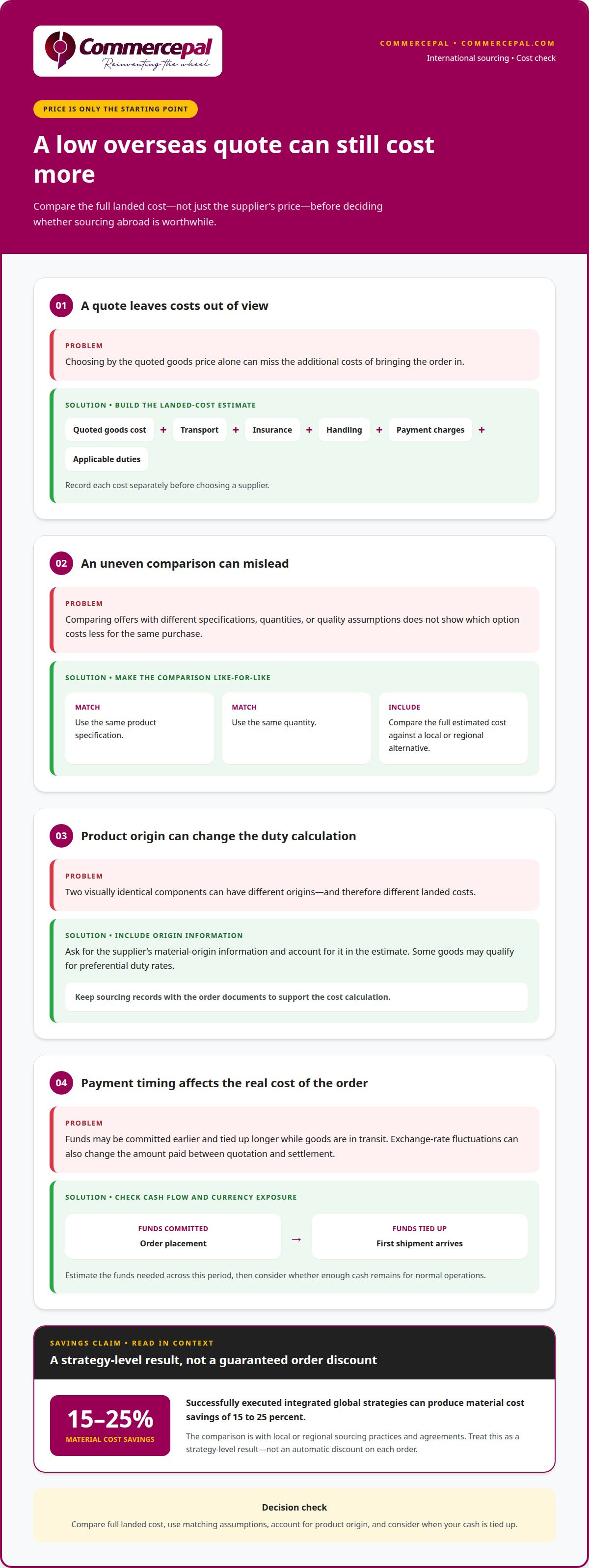
An overseas quote is only one part of the calculation. Successfully executed integrated global strategies can produce material cost savings of 15 to 25 percent. This comparison is with local or regional sourcing practices and agreements. Treat it as a strategy-level result, not an automatic discount on each order.
Estimate landed cost before choosing an overseas supplier. Add the quoted goods cost to transport, insurance, handling, payment charges and applicable duties, and record each item separately. Then compare the total with a local or regional alternative that matches the same specification. Use the same assumptions about quantity and quality for both estimates. Otherwise, you may be comparing unlike offers.
Raw-material origin can affect duty, and some goods may qualify for preferential duty rates. Include the supplier’s material-origin information in your estimate. Two visually identical components can have different origins and therefore different landed costs. Keep sourcing records with the order documents to support your cost calculation.
Payment timing affects the economics, too. Paying an overseas supplier may require an earlier outlay and tie up working capital for longer. Estimate the funds needed from order placement until the first shipment arrives, then consider whether enough cash remains for normal operations. Exchange-rate fluctuations can also change the amount paid between quotation and settlement. Documentation work and possible storage during border delays can add costs.
Compare expected profit margins after estimating the full cost, not just the purchase price. A lower unit quote may lose its advantage if delivery, currency movements or slow inventory turnover absorb the savings. For a discontinued item, account for the possibility of irregular restocking in your cash plan. Choose a sourcing route that fits the expected margin and the time your funds can remain committed. Revisit the estimate if the order quantity, supplier terms or delivery plan changes.
4. How do Incoterms affect shipping costs and responsibility for imported goods
Incoterms are trade terms that help buyers and sellers describe shipping responsibilities in a sales contract. For a shipment to Ethiopia, the chosen term and named place can affect who arranges transport, pays related charges and handles defined steps along the way. Incoterms don’t replace the full contract or settle every question about an order.
Start with the delivery point. “At the supplier’s warehouse” and “at a named destination” describe different handover arrangements. Write the exact place beside the chosen Incoterm, then specify which party books transport and pays each agreed charge. Without a clear location, the buyer and supplier may interpret the same term differently.
Separate transport costs from responsibility for the goods during transit. These are related, but not interchangeable. A party may arrange or pay for a shipping step while responsibility for loss or damage transfers at a different point. Record the agreed handover point, insurance arrangements and process for reporting damage. For example, specify who documents visible damage when a package arrives.
Treat import paperwork and customs charges separately. Incoterms don’t remove the need to understand which import or export requirements apply. State who prepares each document, supplies product details and handles applicable border charges. For goods entering Ethiopia, include the agreed delivery destination and documentation responsibilities in the written order. Don’t rely on a short term to explain every step.
Before paying, compare the supplier’s quotation with the contract. Check that both use the same Incoterm and named place, and that transport, insurance and other charges align. If the supplier quotes delivery to a port but the order assumes delivery to your premises, the difference can affect total cost and handover arrangements. Request the complete arrangement in writing. A precise term, place and schedule of responsibilities make imported-goods costs easier to estimate and disputes easier to address.
CommercePal
CommercePal is a practical option when you’re looking for products in its range instead of managing a direct supplier relationship yourself. Its range includes smartphones and accessories, laptops and computers, health supplements and home appliances. Use the guidance above to decide whether a rare or discontinued item calls for a tailored overseas search, or whether a product in these categories meets your needs. Clear specifications, intended use and compatibility details can help narrow the choice and avoid confusion. For items that depend on exact model numbers or technical requirements, make those details central to your decision. To discuss what you’re looking for, contact CommercePal.
Turn your sourcing decision into a clear next step
Before moving forward, decide what matters most: the exact item, a compatible alternative or the intended function. Write down your essential requirements and the trade-offs you can accept. This gives your next decision a practical starting point, whether you keep exploring international options or consider products available locally. Sourcing hard-to-find items from abroad can open up more possibilities, but the right path depends on how closely an alternative meets your needs.
CommercePal offers smartphones and accessories, laptops and computers, and health supplements. If these categories fit what you’re looking for, use them as a starting point for exploring relevant options. For a conversation about your product needs, contact CommercePal. Take the next step with a clear idea of what you need and remain open to the option that best suits your purpose.
Frequently Asked Questions
What is Global Sourcing, also known as International Sourcing?
Global sourcing is a procurement approach that considers suppliers in multiple countries, rather than limiting the search to a domestic market. The term describes where a business looks for goods or services, not a specific shipping method or supplier type. A buyer might purchase from an overseas vendor, distributor or manufacturer, depending on the item and commercial arrangement.
What is product sourcing?
Product sourcing also involves deciding which items belong in a seller’s range. A business can assess customer demand, product fit and how an item complements existing products before choosing a vendor. For example, a retailer might source a replacement accessory that supports a device already in its catalogue. The sourcing decision shapes both the product choice and the intended customer.
How do I find and vet overseas suppliers for hard-to-find products?
Before approaching a potential supplier to source hard-to-find items from abroad, create a short product brief. Include the intended use, required model or part number, acceptable condition and essential compatibility details. This makes responses easier to compare and helps reveal mismatches early. Keep the item description and supplier correspondence in one record, especially if several similar versions appear during the search.
Which international sourcing platforms and marketplaces are reliable?
Reliability depends on both marketplace processes and individual listings, so a platform name alone doesn’t settle the question. CommercePal aggregates products from Alibaba, Shein and Amazon for Ethiopian shoppers. Assess each listing on its own: review the seller identity, product details, order records and available dispute process. A familiar marketplace can make shopping more accessible, but listings can still differ.
How do I calculate total landed cost for an overseas purchase?
When sourcing hard-to-find items from abroad, calculate the shipment’s total cost, then consider whether you’ll use the item, resell it or keep it as a spare. For resale, estimate the margin using the expected selling price and full acquisition cost. For a replacement part, compare that cost with the value of restoring the equipment. The intended use can change the purchasing decision.
How do I verify product safety, certifications and EU compliance before importing?
Start by identifying the exact product model, its intended use and the destination market. Request product documents that clearly match the model being offered, rather than relying on paperwork for a similar item. Record the document names and model identifiers with the order. For products with safety implications, assess the requirements relevant to the destination and intended use before deciding to import.


