

The key number is Ethiopia’s standard VAT rate: 15%. To calculate import tax for online shopping in Ethiopia, start with VAT, then account for customs duty, which can range from 0% to 35% depending on the goods. The final duties are determined after Ethiopian customs assesses the shipment.
Ordering from the United States can make the final cost feel uncertain. To calculate import tax for online shopping in Ethiopia, account for the product and how the shipment is handled: the listed item price alone may not show the full amount due.
This guide explains how VAT and customs duty fit into the calculation, what information Ethiopia’s customs calculator requires, and how DDP and DDU affect when import charges are paid. You’ll also learn how to estimate costs before ordering, compare the product price with the likely landed cost, and plan for delivery.
Key Takeaways
- Use Ethiopia’s standard VAT rate of 15% as a starting point, then account for customs duty based on the item’s classification.
- Find the product’s six- or eight-digit HS code to use the Ethiopian customs calculator and build a more useful estimate.
- Compare DDP and DDU terms to understand whether import charges are included in the delivery arrangement or paid separately.
- Consider the full landed cost before ordering, since the product value alone doesn’t show every charge that may apply.
How is import tax calculated for shipping to ETHIOPIA ?
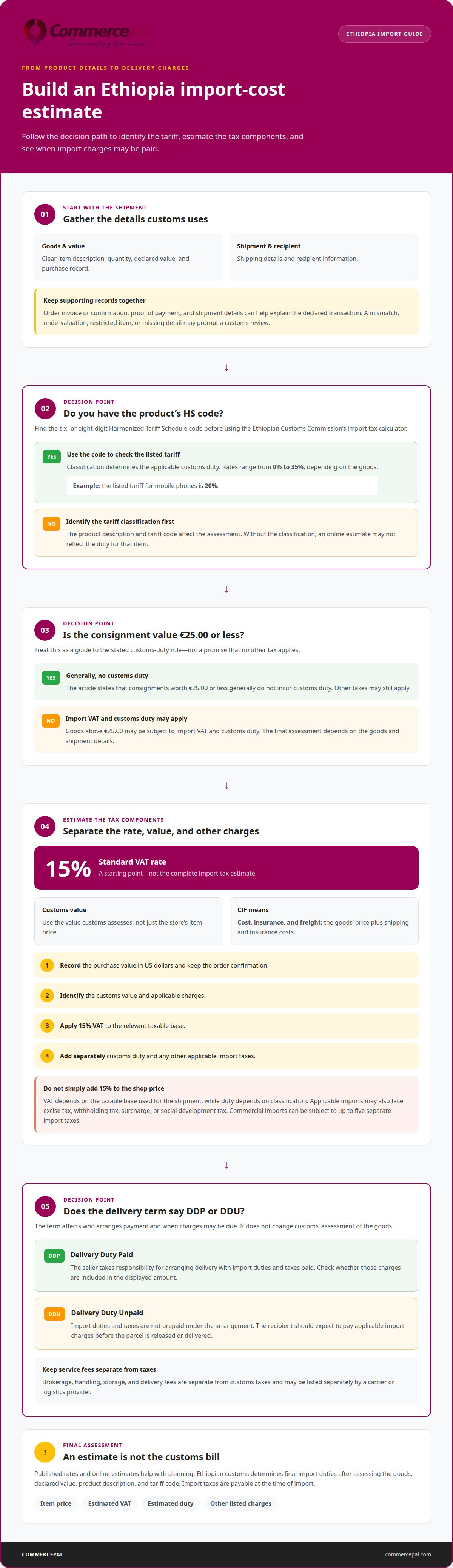
For a parcel entering Ethiopia, customs considers the goods, their declared value, and applicable taxes. Start by identifying the item’s tariff classification, then estimate charges using its customs value.
Customs Duties and Taxes
Ethiopian customs duty rates range from 0% to 35%, depending on the product’s classification. Applicable imports may also face VAT, excise tax, withholding tax, surcharge, or social development tax. Commercial imports can be subject to up to five separate import taxes. Look beyond the product price: the item type and customs value influence the total due.
Customs Assessment and Rate Caveats
Ethiopian customs determines the final import duties after assessing the goods. Published rates and online estimates are useful for planning, but the product description, declared value, and tariff code all affect the assessment.
Prepare the order invoice or confirmation, proof of payment, shipment details, a clear item description, quantity, declared value, and recipient information. A mismatch, undervaluation, restricted item, or missing detail may prompt a customs review. A held parcel remains pending clearance until the issue is resolved.
Customs Value and CIF Calculation
Use the customs value, not just the store’s item price, to estimate duty. CIF means cost, insurance, and freight: it combines the goods’ price with shipping and insurance costs. Keep these amounts and the purchase record available so you can see how the declared customs value was calculated. Customs assessment determines the value used for the final calculation.
Tariff Classification and Duty Thresholds
Find the product’s six- or eight-digit Harmonized Tariff Schedule code before using the Ethiopian Customs Commission’s import tax calculator. Classification matters: the listed tariff for mobile phones is 20%, while duty rates vary across goods. Consignments worth €25.00 or less generally do not incur customs duty; goods above €25.00 may be subject to import VAT and customs duty. Treat the threshold as a guide to the stated duty rule, not a promise that no other tax applies.
Listed Ethiopia VAT rate
Ethiopia’s listed standard VAT rate is 15.00%. For an online purchase arriving from the United States, use that rate as a starting point, not as the parcel’s complete import-tax estimate. Customs duty and other applicable taxes can affect the amount due alongside VAT.
To understand the calculation, separate the rate from the taxable base. The rate is the percentage applied; the taxable base is the value customs uses to calculate VAT. This arithmetic explains how the rate works, but it does not guarantee the customs bill for an actual parcel.
Use these steps to make a preliminary estimate:
- Record the purchase value in US dollars and keep the order confirmation.
- Identify the parcel’s customs value and applicable charges.
- Apply the 15.00% VAT rate to the relevant taxable base.
- Account separately for customs duty and any other applicable import taxes.
Don’t simply add 15% to the shop price and treat the result as the total. The calculation depends on the taxable base used for the shipment, while duty depends on the goods’ classification. A phone and a different product can therefore have different total charges, even if their prices match.
Import taxes are payable at the time of import. Keep the seller’s invoice, payment record, product description, and shipping details together. These records help explain the declared transaction and make it easier to compare your estimate with the customs assessment.
For a practical comparison, write down the item price, estimated VAT, estimated duty, and any other listed charge as separate amounts. This makes the effect of the 15.00% VAT rate clearer and helps prevent it from being mistaken for the full tax rate. Use the final customs assessment to understand the amount due on the parcel.
Delivery Duty Paid and Delivery Duty Unpaid
DDP and DDU describe different arrangements for handling import charges on shipments to Ethiopia. Check the delivery term before paying: it affects who arranges payment and when you may need to pay charges. Neither term changes customs’ assessment of the goods.
With Delivery Duty Paid (DDP), the seller takes responsibility for arranging delivery with import duties and taxes paid. The checkout or shipping terms should clarify whether those charges are included in the displayed amount. Compare the wording with the final order details instead of assuming that “delivered” means every import cost is covered.
With Delivery Duty Unpaid (DDU), import duties and taxes are not prepaid under the arrangement. The recipient should expect to pay applicable import charges before the parcel is released or delivered. Since Ethiopia’s import taxes are payable at the time of import, a DDU shipment may require payment during clearance.
Brokerage, handling, storage, and delivery fees are separate from customs taxes. A carrier or logistics provider may list these service charges separately, depending on the shipment arrangement and services provided. Review the shipment terms and any charge breakdown to distinguish service fees from taxes.
Before placing an online order from the United States, review these details:
- Look for DDP or DDU in the seller’s delivery terms and checkout summary.
- See whether duties and taxes are described as included or payable by the recipient.
- Keep the seller’s invoice and shipment information available for customs processing.
- Set aside the stated import charges and any separately listed carrier fees if the terms make you responsible.
For a practical comparison, consider the full amount you may pay, not just the checkout total. A DDP price may combine the goods, shipping, and prepaid import charges; a DDU price may leave import costs and separate service fees to be paid later. Clear terms show which charges are prepaid and which may be collected during delivery.
Ethiopia import-tax calculation method
Estimate import charges by entering the product’s customs code and value in Ethiopia’s online customs calculator. The result helps you plan, but the final duties depend on customs assessment.
Start with the item’s six- or eight-digit Harmonized Tariff Schedule code. The Ethiopian Customs Commission calculator requires this code to identify the product category used to estimate duties and taxes. Then enter the value and select the closest matching description. A code for a different item may produce an estimate that does not fit your purchase.
Use this sequence to build an estimate:
- Find the product code that matches the item being shipped.
- Enter the declared value in the calculator’s requested currency.
- Review the displayed tax and duty rates separately.
- Add the displayed tax and duty amounts to see the estimate total.
For example, the calculator’s “Accessory (no-battery)” category is associated with HS Code 85171400. Its example displays an estimated tax rate of 15.00% and an estimated duty rate of 50.00%. Treat those figures as that calculator example, not as a rate for every accessory.
Separate charges matter. Ethiopia’s stated surcharge rate is 10%, withholding tax is 3%, and social development tax is 3%. Which taxes apply depends on the import and its classification. The calculator estimate should therefore be read line by line, rather than as one universal import-tax percentage.
For a useful estimate, match the code to the exact product, enter the purchase value, and keep the invoice details for comparison. A broad description such as “electronics” may not identify the item precisely enough. Compare the calculator’s displayed categories and totals with your shipment details, then rely on the customs assessment for the final amount payable.
CommercePal: Smartphones & Accessories
CommercePal offers smartphones and accessories for shoppers comparing products before ordering. Follow the customs calculation steps above to estimate how an item’s classification may affect import charges, then consider the full cost of your planned purchase.
Browse available categories, including laptops and computers, health supplements, and home appliances. Match the item you’re considering to its product details, then use those details to estimate its tariff classification and potential taxes. This connects your shopping decision to the practical import-cost factors in this guide.
Explore CommercePal’s relevant product categories for your next purchase, or contact CommercePal with your shopping enquiry.
Make your next order with a clearer plan
Use this approach to calculate import tax for online shopping in Ethiopia before committing to a purchase. Treat the estimate as one part of your buying decision, alongside the item and delivery terms. Keeping product details and order records together also gives you a useful reference during shipping.
If you’re choosing a smartphone, laptop, or health supplement, CommercePal offers these categories for online shoppers. Compare products that fit your needs, then consider the import-cost factors in this guide as you plan your order. An informed purchase starts with understanding what you’re buying and how it will be shipped.
Ready to take the next step? Contact CommercePal about your shipment and continue planning your online purchase with confidence.
Frequently Asked Questions
How is VAT applied to packages sent from the United States to the Ethiopia?
Ethiopia applies its standard 15% VAT rate to the taxable base used for the import assessment. The parcel’s origin in the United States doesn’t by itself determine the VAT amount. Customs value, applicable duty, and the product’s classification shape the calculation. Keep the item invoice and shipping records together so you can understand the declared value used for the shipment.
How to calculate duties and taxes?
Calculate each charge separately, then add them to estimate the total. For illustration, a calculation example applies 7% duty to a $200 declared value, producing $14 in duty. These are example rates, not Ethiopia’s rates for your goods. For Ethiopia, use the applicable product classification and customs assessment.
What are the current import duties for goods shipped from the US to the ET?
Ethiopian customs duty rates range from 0% to 35%, and the product category determines the applicable rate. Examples include 0% for documents, 1% for books, 6% for jewelry, 12% for pet accessories, and 14% for dry food. These examples show why a shipment’s US origin alone can’t identify its duty rate. Classification is key.
What is a duty?
A duty is a charge customs applies to imported goods under the relevant tariff classification. For example, a product assigned a 12% duty rate is assessed differently from documents listed at 0%. Duty is distinct from VAT and other import taxes, which can also contribute to the total. Check the product category and rate, rather than treating every import charge as one tax.
What is the meaning of duty and tax-paying value?
Duty- and tax-paying value is the customs-assessed value used to calculate import charges. It may differ from the amount paid at checkout or the final total owed. Customs value and charges are separate parts of the calculation: the value provides the base, while each applicable duty or tax rate determines a charge against it.
How is import tax calculated on online shopping shipments to Ethiopia?
For an online order, identify the product’s tariff code, declared value, and applicable tax rates, then calculate each charge separately. Enter the required product code in the Ethiopian Customs Commission calculator to get an estimate. Keep the order invoice and a precise item description handy. Customs assessment determines the final duties and taxes payable on the shipment.


