
A practical USD card alternative for online shopping in Ethiopia is a virtual card funded in US dollars. It is designed for online use and can work on global platforms that accept USD payments. The right option depends on whether your preferred stores accept the card and whether its transaction limits suit your purchases.
It’s natural to focus first on finding a card that works, then wonder what the final charge will be in Ethiopian Birr (ETB). Currency conversion and spending limits can affect a purchase, so compare those details before choosing. This guide explains how virtual USD cards work, what to consider about ETB settlement and conversion, and how to assess transaction limits. You’ll be better equipped to decide whether a card fits your online shopping needs in Ethiopia.
Key Takeaways
- Check where Visa and Mastercard are accepted, and assess transaction limits separately from merchant acceptance.
- Consider whether an ETB card can make payments in the currency a foreign merchant requires before choosing how to pay.
- Understand how ETB settlement and currency conversion affect the amount charged for an international purchase.
- Compare virtual USD card options with your shopping needs, including whether the platform accepts USD payments.
Are there daily limits on Forex card transactions?
Daily spending limits vary by card and issuer. In Ethiopia, merchant acceptance is another hurdle: a spending limit won’t help if the merchant can’t process the card.
- Check acceptance before relying on a Visa or Mastercard for international purchases. In Ethiopia, these cards have limited use for e-commerce and international payments. They are accepted mainly at major hotels, airlines, and some tourist shops. A logo on a checkout page doesn’t guarantee that a transaction from Ethiopia will go through. Consider merchant acceptance separately from your card’s spending limit.
-
Review spending limits and verification levels
Review the card’s daily spending limit and the verification level required to use it. These can affect how much you can spend, even when your dollar balance covers the order. Check whether the limit applies to online purchases, total daily spending, or both. Compare it with your expected checkout amount, and don’t assume that a bank account balance increases the card limit.
-
Confirm transaction limits
Check the per-transaction limit as well as the daily cap. A purchase may fit within the daily allowance but exceed the maximum for a single transaction. Look for separate rules for online and international payments, as a card may restrict one without blocking the other. Review your statement after a test purchase to see how the charge appears and whether it was processed as expected.
- Review ATM withdrawal limits and fees separately from online spending. Withdrawing cash is different from paying a foreign merchant, so the card may apply different controls. In Ethiopia, ATMs are not always reliable. Check the withdrawal terms and any displayed ATM fee before confirming, then plan another payment method if you need cash. Don’t assume a card with a high shopping limit also offers convenient cash withdrawals.
How to Choose the Best Forex Card for Ethiopia?
Choose a payment method based on where you shop and how the merchant processes payments. In Ethiopia, an ETB card may be declined if a foreign checkout requires another currency or rejects the card’s issuing region.
-
Review Ethiopian payment apps and virtual cards
Distinguish local payment apps from virtual cards before choosing how to pay. Telebirr, CBE Birr, and eBirr are local Ethiopian payment methods, so don’t assume they provide virtual cards for international online shopping. A virtual USD card is an online-only card funded in dollars, usable on global platforms that accept USD payments. Match the payment method to the checkout currency and platform.
-
Consider third-party and crypto-funded card risks
Before using a third-party or crypto-funded option, assess who controls the card, wallet, and account access. If you rely on another person or service, a frozen account or lost credentials may interrupt payments or complicate refunds. Crypto-funded balances can also change in value before purchase. Keep access details private, understand how refunds are returned, and avoid funding a card through a wallet you can’t control.
- Check whether the card fits the merchant’s payment setup. A foreign store may decline an ETB card if its processor doesn’t support the issuing country, currency, or card type. Forex cards can support online and in-store purchases where accepted, but a network logo alone doesn’t guarantee approval. Check the checkout currency and compare it with the card’s funding currency before submitting payment.
- Keep a local backup for purchases that don’t accept cards. Cash in Ethiopian Birr is widely used for everyday payments, especially outside major commercial centres, and cash on delivery remains a common retail option. Since ATMs aren’t always reliable, don’t depend on a withdrawal as your only backup. If a card is lost or a payment is disputed, contact the issuer through its official channel and keep the transaction statement and order receipt.
ETB settlement and foreign-currency conversion
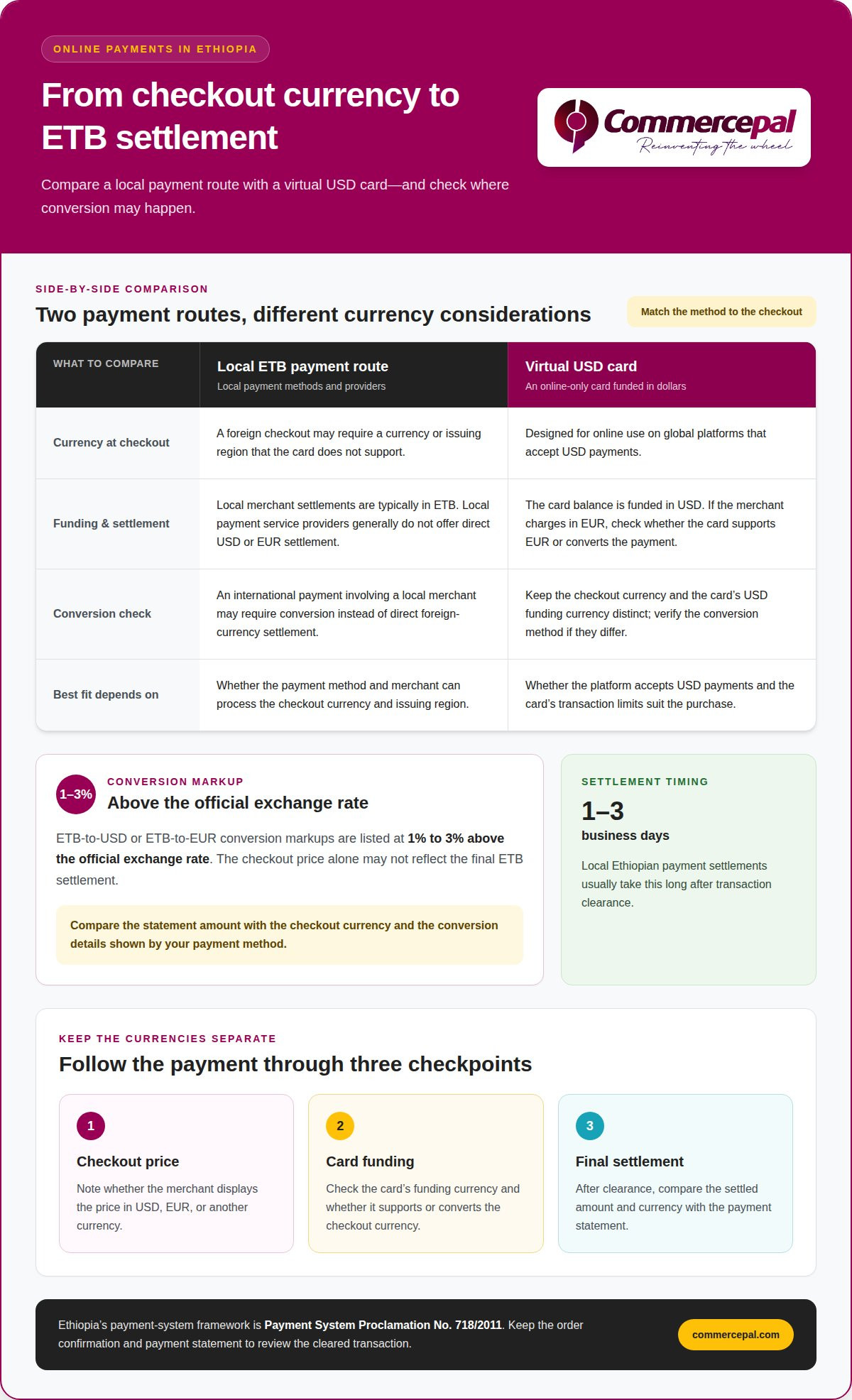
For online purchases in Ethiopia, distinguish the currency shown at checkout from the currency ultimately used for settlement. Ethiopia’s payment-system framework is Payment System Proclamation No. 718/2011; local merchant settlements are typically in ETB.
-
Check supported currencies
Match the merchant’s checkout currency with the currencies your payment method supports. Global platforms may show prices in USD or EUR, while Ethiopian merchants typically receive settlements in ETB. Local payment service providers generally don’t offer direct USD or EUR settlement. So an international payment involving a local merchant may require conversion rather than delivering foreign currency directly to the merchant. Check the displayed currency before paying.
-
Review conversion and markup fees
Review the conversion method and markup before approving a foreign-currency transaction. ETB-to-USD or ETB-to-EUR conversion markups are listed at 1% to 3% above the official exchange rate. This markup affects the converted amount, so the checkout price alone may not reflect the final ETB settlement. Compare the amount charged with the currency and conversion details shown on your payment statement.
-
Confirm card currency and loading
Confirm the card’s funding currency and how its balance is loaded. A virtual USD card is funded in US dollars and designed for online use. If the merchant charges in EUR, check whether the card supports that currency or converts the payment. Keep the checkout currency, card balance currency, and expected converted amount distinct. This makes the payment easier to understand and helps you spot an unexpected conversion.
- Allow for settlement timing when planning a purchase or refund. Local Ethiopian payment settlements usually take 1-3 business days after transaction clearance. Settlement timing differs from the moment you submit payment, so a pending transaction may not yet appear as a completed settlement. Save the order confirmation and payment statement. Compare their amounts and currencies once the transaction clears, especially when a foreign merchant charges in USD or EUR.
Using a USD Visa or Mastercard for online shopping in Ethiopia
A virtual USD card is an online-only card funded in dollars and usable on global platforms that accept USD payments. Visa and Mastercard have limited use for e-commerce and international payments in Ethiopia, so distinguish card availability from merchant acceptance. A USD card alternative for online shopping in Ethiopia may work for eligible online checkouts, but the store must still accept its payment network and currency.
-
Check cards available to Ethiopian residents
Start by matching a virtual card to the store’s checkout currency and payment requirements. A virtual USD card provides an online option for platforms that accept USD payments, but it isn’t a physical card for every purchase. Before paying, confirm that the merchant accepts the card network and currency. Acceptance in other countries doesn’t mean a merchant will accept a card issued in Ethiopia.
-
Confirm bank-issued international card options
Distinguish card issuance from acceptance by a foreign merchant. Ethiopian bank card products and their permitted payment channels may differ, and an international network logo alone doesn’t show that online payments abroad are enabled. Visa and Mastercard use for e-commerce and international payments in Ethiopia is limited. Treat the issuer’s card terms, payment channel, and merchant’s checkout options as separate factors.
-
Use a USD Visa or Mastercard online
For a USD card alternative for online shopping in Ethiopia, choose a virtual card only when the platform accepts USD and its network. A dollar-funded card can match an order priced in USD, while a purchase in another currency may involve conversion. Keep the checkout confirmation and payment statement so you can compare the charged currency and amount afterward.
- Before ordering, follow a simple sequence: identify the checkout currency, confirm the card supports it, and check the merchant’s accepted payment methods. Then ensure the balance covers the purchase and any conversion. A USD-funded virtual card suits a platform accepting USD payments; a store requiring another currency needs a compatible payment route. Card availability doesn’t guarantee acceptance abroad.
CommercePal
CommercePal offers a convenient next step when you’re ready to shop locally after comparing card options. Browse smartphones and accessories, laptops and computers, health supplements, and home appliances. You can pay using Ethiopian methods such as Telebirr, CBE Birr, and eBirr, giving you local payment choices for purchases on the platform.
Your card research can help with international checkouts, while a local payment method may suit purchases available through CommercePal. Choose the product category that fits your needs, then select a payment option that works for your order. For help shopping through CommercePal, contact the team.
Make your next purchase with a clear plan
Choose an approach that fits the purchase, not just the card label. A USD card alternative for online shopping in Ethiopia should suit the store’s accepted payment methods, checkout currency, and the way you want to pay. For local purchases, consider the payment options available to you too. This gives you a practical route from browsing to checkout, whether you’re buying online from abroad or choosing products available through CommercePal.
CommercePal offers smartphones and accessories, laptops and computers, and health supplements. If one of these categories fits your next purchase, you can explore it while applying what you’ve learned about payment choices. For questions about shopping with CommercePal, contact CommercePal for help. Take the next step at your own pace, and choose the option that works for your order.
Frequently Asked Questions
What Is a Virtual USD Card and Why Do You Need One?
A virtual USD card is an online-only card funded in US dollars. It can help you pay on global platforms that accept USD payments, without using a physical card at checkout. For example, if a store prices an order in dollars, a virtual card may provide a direct online payment option. Its usefulness depends on whether the merchant accepts its network and payment type.
What are the eligibility requirements and documents for getting an international card in Ethiopia?
Eligibility and required documents depend on the institution issuing the card and the card product. Follow its application process and enter accurate identity and account details in the requested fields. Keep your details consistent across the application, account, and payment profile. Before submitting, review the issuer’s eligibility criteria and make sure the card supports the type of international purchase you plan to make.
What fees, exchange rates, and top-up charges apply to USD cards available in Ethiopia?
Costs can include card transaction charges, currency conversion, and top-up fees, with the amounts depending on the card and transaction. For ETB-to-USD or ETB-to-EUR conversion, listed markups are 1% to 3% above the official exchange rate. Separate that conversion markup from any card or loading charge, and compare the total shown for your payment rather than focusing on one fee alone.
How can Ethiopians fund a virtual USD card using birr or local bank accounts?
Funding routes depend on the virtual card’s supported loading methods. If the issuer permits local account funding, follow its payment instructions and check how deposited ETB becomes a USD balance. Keep the funding confirmation and compare the credited amount with the transaction record. Don’t assume a local bank account or payment app can load every virtual card; the card’s supported methods determine the available route.
How do USD card options in Ethiopia compare on availability, fees, limits, and acceptance?
Compare options across four points: whether residents can obtain the card, how it is funded, which transaction limits apply, and where its network is accepted. Then review conversion and loading charges separately. A card may suit a USD checkout but still fail on a platform that doesn’t accept its network or issuing region. Choose based on the store and purchase type you actually use.
How can someone apply for and activate an international or virtual card in Ethiopia?
Start through the card issuer’s application channel and submit the identity and account information it requests. Follow the issuer’s activation steps before entering the card details at checkout. For a virtual card, keep the card number and security details private, then confirm that the card is active and funded. A small purchase on a platform that accepts the card can help test the payment setup.


